13 January 2026
Restaurant Operations & Management
How WhatsApp Billing Improves Restaurant Customer Experience & Payment Speed
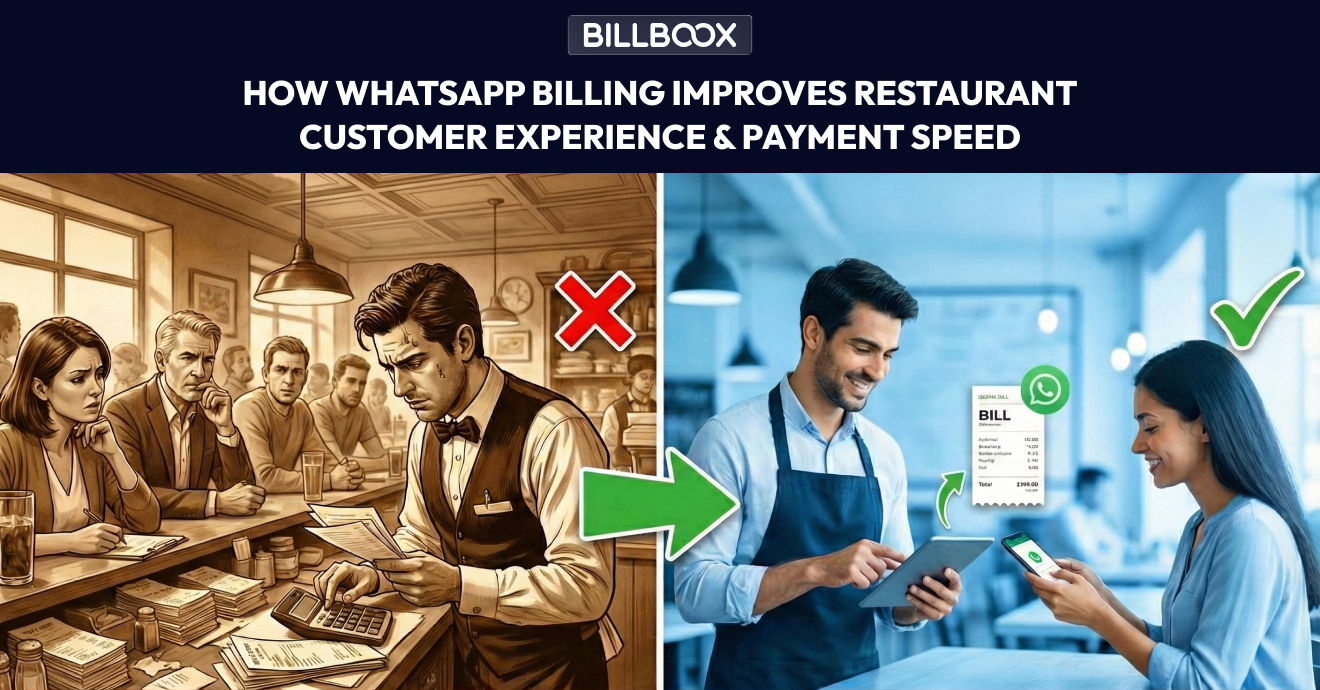
Billing is often the last interaction a customer has with your restaurant - and unfortunately, it’s also where many good dining experiences fall apart.
A packed dinner service, staff juggling multiple tables, a slow printer, or customers lining up at the counter just to pay. These moments may seem routine, but they directly influence how customers remember your restaurant.
Over the last few years, many restaurants have started shifting toward WhatsApp billing for restaurants as a way to simplify checkout, reduce friction, and match modern customer expectations - without disrupting kitchen or service workflows.
This guide explains what WhatsApp billing actually solves, where it fits into restaurant operations, and how to evaluate whether it’s the right move for your restaurant.
Is WhatsApp Billing Right for Your Restaurant?
This guide is useful if you are:
- Running a dine-in restaurant, café, QSR, or bar
- Experiencing payment delays during peak hours
- Handling frequent billing-related questions or errors
- Looking to reduce counter congestion
- Exploring digital billing restaurant options beyond paper bills
This guide is not written for:
- Restaurants that operate strictly on cash-only models
- Extremely low-volume outlets with minimal dine-in traffic
The Real Problem Restaurants Face (Operational Reality)
Most billing problems don’t come from software - they come from rush-hour pressure.
Common real-world scenarios:
- Five tables ask for the bill at the same time
- One printer serves the entire floor
- Staff manually re-checks totals while customers wait
- A customer asks for a copy of the bill after leaving
- Small billing errors turn into awkward conversations
These moments slow down:
- Payments
- Table turnover
- Staff movement
And they often happen daily, not occasionally.
How Restaurants Typically Handle Billing Today
1. Paper Bills from POS
- Printed after the order is closed
- Carried physically to the table
- Payment happens at counter or table
Limitations:
- Printer dependency
- Physical movement delays
- Easy to misplace
2. Basic Digital Billing (PDF or SMS)
- Bill shared manually as a PDF
- Sometimes sent via SMS or email
Limitations:
- Requires manual effort
- Low open rates
- Customers often don’t notice it immediately
This is where WhatsApp restaurant billing enters as a practical middle ground.
What Is WhatsApp Billing for Restaurants?
WhatsApp billing for restaurants means sending a customer’s final bill directly to their WhatsApp number from the POS system.
Typically, the customer receives:
- Itemized bill
- Taxes and totals
- Optional payment link or QR reference
- A bill they can save and access later
It doesn’t change how orders are taken or prepared - it only changes how the bill reaches the customer.
How WhatsApp Billing Improves Customer Experience
Familiar Platform, Zero Learning Curve
WhatsApp is already part of customers’ daily behavior.
There’s no new app, login, or explanation needed.
This familiarity reduces friction at a moment when customers want to leave smoothly.
Less Waiting, Less Confusion
When bills are sent instantly:
- Customers review them at the table
- Staff doesn’t need to rush back and forth
- Payment conversations become shorter and clearer
Restaurants using WhatsApp billing often notice fewer “Where is the bill?” or “Can you send it again?” interruptions during peak hours.
Clear Records for Customers
WhatsApp bills:
- Stay on the customer’s phone
- Are easy to retrieve later
- Reduce follow-up calls for copies
This is especially useful for business diners and corporate customers.
How WhatsApp Billing Improves Payment Speed
Removes Counter Bottlenecks
Instead of everyone gathering at the billing desk:
- Bills go out in parallel
- Payments can happen simultaneously
- Staff movement reduces significantly
This matters most during lunch and dinner rushes.
Supports Modern Payment Habits
UPI and QR payments are now default behavior for many diners.
When paired with WhatsApp bill software, customers don’t feel rushed or confused - they complete payment at their own pace.
Faster Table Turnover
Even saving 2–3 minutes per table:
- Frees seating earlier
- Reduces waiting customers
- Improves daily revenue potential
What to Evaluate Before Choosing a WhatsApp Billing Solution
Before enabling WhatsApp billing, restaurants should evaluate:
- Automation – Is the bill sent automatically from POS or manually?
- Accuracy – Does it reflect live order data correctly?
- Compliance – Is GST handled properly?
- Fallback – Can you still print bills if needed?
- Staff Simplicity – Can non-technical staff use it easily?
A good POS with WhatsApp billing should simplify operations, not add steps.
How BillBoox Fits into This Ecosystem
Within this ecosystem, BillBoox positions WhatsApp billing as a supporting workflow inside its restaurant POS software, rather than as a standalone feature.
Feature → Situation → Outcome
- POS-generated WhatsApp bills
→ Rush-hour billing requests
→ Faster checkout, fewer queues - Digital bill history
→ Customers asking for past bills
→ Reduced staff follow-ups - Integrated billing & reporting
→ GST filing and audits
→ Fewer manual mismatches
BillBoox is designed for restaurants that want operational clarity, not just digital billing.
Who This Is NOT For
WhatsApp billing may not be ideal if:
- Your customers rarely use smartphones
- You operate in remote areas with poor internet
- Your outlet has extremely low dine-in volume
In such cases, simpler billing methods may still work fine.
Balanced Comparison: When WhatsApp Billing Makes Sense
Ideal When:
- You handle high dine-in traffic
- Peak hours create billing delays
- Customers prefer digital payments
- Staff multitasking is a challenge
Simpler Tools May Work When:
- Daily order volume is very low
- Customers insist on printed bills only
- Operations are single-person managed
The decision should be context-driven, not trend-driven.
Practical Use Cases
- Busy cafés during lunch breaks
- Family restaurants on weekends
- Bars managing quick exits
- Corporate dining with reimbursement needs
In all cases, WhatsApp billing reduces friction at checkout the most sensitive moment of the visit.
Frequently Asked Questions(FAQs)
1. What is WhatsApp billing for restaurants?
It is a method of sending restaurant bills directly to customers via WhatsApp using a POS system.
2. Is WhatsApp billing legal and GST-compliant in India?
Yes, if the bill is generated through a GST-compliant POS. WhatsApp is only the delivery channel.
3. Do customers need any special app?
No. Customers only need WhatsApp, which most already use.
4. Does WhatsApp billing replace printed bills?
Not necessarily. Many restaurants use it alongside printed bills as an option.
5. Is WhatsApp billing suitable for small restaurants?
Yes, especially if they face counter congestion or staff limitations.
6. What happens if WhatsApp delivery fails?
A good system allows re-sending or fallback to printed billing.
Final Summary
WhatsApp billing is not about technology - it’s about removing friction at the most critical point of the dining experience.
For restaurants dealing with rush hours, payment delays, or customer impatience, Whatsapp billing for restaurants offers a practical, familiar, and low-effort improvement.
The key is choosing a solution that fits your operation not one that complicates it.
tags :
Restaurant billing
Whatsapp billing for restaurants
Restaurant POS
Digital billing restaurant
Whatsapp restaurant billing
Restaurant payments
Customer experience
Restaurant operations
Billing automation
Payment speed
Indian restaurants