14 January 2026
Restaurant Operations & Management
How Real-Time Reports Help Restaurant Owners Make Better Decisions
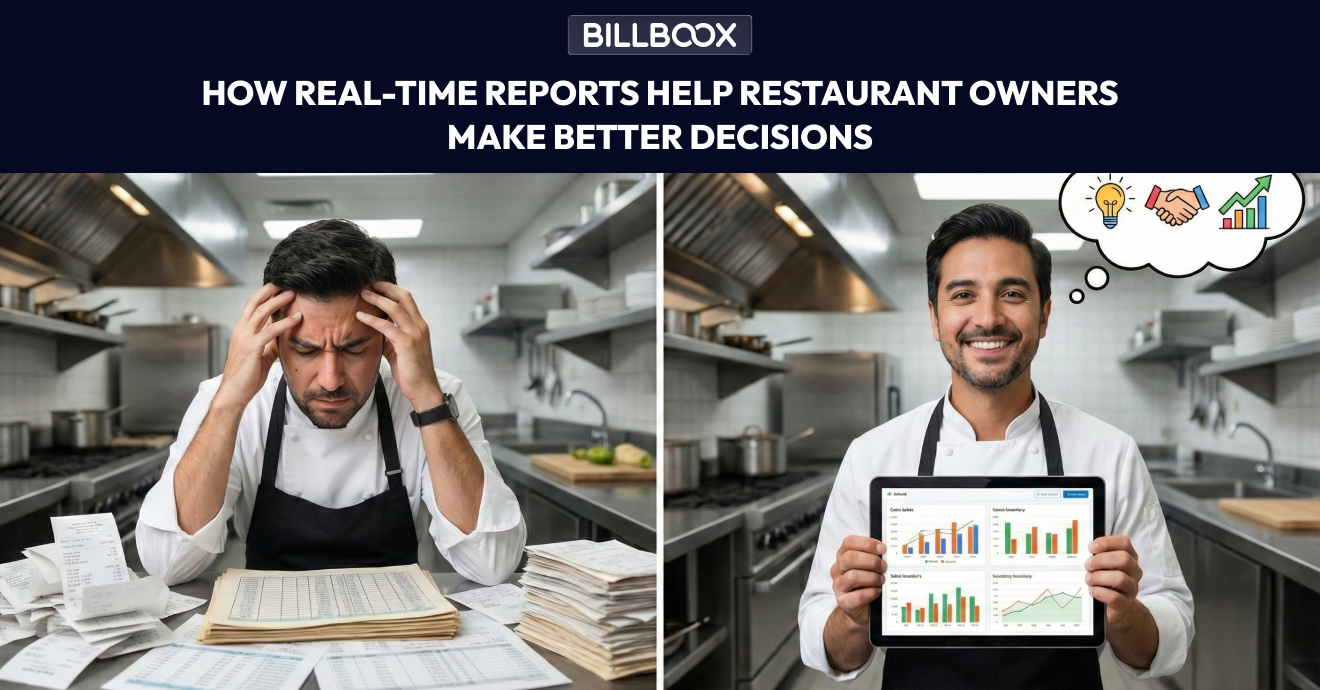
Real-Time Restaurant POS Reports: A Practical Guide to Smarter Sales Decisions
Running a restaurant means making decisions every single day - often under pressure and with limited time.
Should you reorder ingredients today or wait until tomorrow?
Was yesterday’s discount actually profitable?
Is one outlet underperforming, or was it just a slow day?
Many restaurant owners still rely on gut feeling or end-of-day summaries to answer these questions. But by the time those reports are reviewed, the opportunity to act has often already passed.
This is where restaurant POS reports and real-time restaurant sales reporting software change how decisions are made - not by adding complexity, but by showing the right numbers at the right time.
This guide explains how real-time reporting works in restaurants, what problems it solves, and how owners can use restaurant POS sales reports to make clearer, faster, and more confident decisions.
Is Real-Time Restaurant Reporting Relevant for Your Business?
This guide will be useful if you:
- Own or manage one or more restaurant outlets
- Regularly review restaurant daily sales reports
- Use a POS but want deeper reporting visibility
- Want clarity on item performance and payment splits
- Feel decisions are reactive instead of proactive
This guide may not be relevant if:
- Your restaurant runs extremely low daily volume
- You do not track sales digitally
- Your operations are stable and rarely fluctuate
The Real Operational Problem: Delayed Information
Most restaurant decision problems do not come from lack of effort - they come from delayed visibility.
Common real-world situations:
- You discover a sales drop only the next morning
- A fast-moving item goes out of stock mid-service
- Discounts are applied, but their impact is unclear
- Staff performance issues surface too late
- Cash and digital totals don’t match at closing
These gaps often result in:
- Missed revenue opportunities
- Inventory wastage
- Staff inefficiencies
- Stressful reconciliations
The issue is not data availability.
It is data timing.
How Restaurants Typically Handle Sales Reports
1. End-of-Day Manual Summaries
- Sales reviewed after closing
- Totals calculated manually
- Decisions pushed to the next day
Limitations:
- No ability to act during service
- Trends noticed too late
- Higher risk of human error
2. Static POS Sales Reports
Most POS systems generate reports, but many restaurants check them only once a day.
These traditional POS sales reports show:
- Total daily sales
- Payment splits
- Basic item summaries
Limitations:
- Data reflects what already happened
- No live visibility
- Difficult shift-wise or outlet-wise comparison
This is where real-time restaurant POS reporting software makes a meaningful difference.
What Are Real-Time Restaurant POS Reports?
A restaurant POS report is generated directly from billing transactions inside the POS system.
With real-time restaurant sales reports software, data updates automatically as orders are placed - not hours later.
Owners can typically view:
- Live sales totals
- Item-wise performance
- Category-level trends
- Payment method breakdown
- Outlet and shift comparison
- Discount impact
- Staff-level activity
Instead of waiting for exported summaries, restaurant POS reports continuously update during operations.
Restaurant POS Reports vs Traditional Sales Reports
Understanding this distinction is critical for operational control.
| Feature | Traditional Sales Reports | Real-Time Restaurant POS Reports |
|---|---|---|
| Data Timing | End of day | Live updates |
| Accuracy | Manual validation needed | Automated from billing |
| Multi-Outlet Visibility | Limited | Centralized dashboard |
| Discount Monitoring | Post-analysis | Live tracking |
| Decision Speed | Delayed | Immediate |
For growing restaurants, automated restaurant sales reporting software reduces the gap between problem detection and action.
How Real-Time Restaurant Sales Reports Improve Decision-Making
1. Clear Visibility During Service
With live restaurant POS reports:
- Slow periods can be identified early
- High-performing items can be promoted
- Underperforming items can be analyzed
- Peak hours become measurable
Small operational adjustments can be made while service is still running.
2. Better Inventory Planning
When sales data is visible in real time:
- Stock shortages can be anticipated
- Reordering becomes data-driven
- Over-purchasing reduces
- Wastage decreases gradually
This becomes even more effective when reporting is integrated with a Restaurant Inventory Management System.
3. Faster Issue Detection
Real-time reporting helps identify:
- Sudden drops in sales
- Unusual discount patterns
- Payment mismatches
- Shift-level inconsistencies
Early detection prevents revenue leakage.
The Role of POS Reporting in Modern Restaurant Operations
A POS sales report forms the foundation of reporting - but timing determines usefulness.
Traditional POS reports show:
- What already happened
Modern cloud-based restaurant reporting software shows:
- What is happening right now
For restaurants evaluating systems, reporting capabilities should be considered alongside core billing features and Restaurant POS Pricing in India.
Real-Time Reporting and Online Delivery Performance
Restaurants operating on aggregators must track discounts and commissions carefully.
For example, understanding delivery platform margins becomes clearer when connected with reporting dashboards that show real-time sales and discount impact.
You can explore this further in our detailed guide on Zomato commission breakdown breakdown for restaurants.
What to Look for in Restaurant Reporting Software
When evaluating restaurant POS reporting software, consider:
Accuracy – Does it reflect actual orders and payments?
Speed – Are updates instant?
Clarity – Can reports be understood easily?
Flexibility – Can you compare days, weeks, shifts, or outlets?
Accessibility – Can you access reports remotely?
Scalability – Will it support multiple outlets as you grow?
A strong restaurant analytics system should simplify decisions - not overwhelm owners with dashboards.
How BillBoox Supports Real-Time Restaurant Reporting
BillBoox treats reporting as a decision-support system, not just record-keeping.
Feature → Situation → Outcome
Real-time sales dashboard
→ Owner monitoring live performance
→ Faster corrective action
Item-level restaurant POS reports
→ Identifying top and low performers
→ Smarter menu planning
Outlet & shift comparison
→ Managing multiple locations
→ Better staffing decisions
The goal is clarity, speed, and operational control.
Who Real-Time Reporting May Not Be Ideal For
Real-time restaurant reporting may not be necessary if:
- Reports are reviewed only weekly
- Operations are extremely small and stable
- Sales rarely fluctuate
- Decision-making is fully delegated
In such cases, basic POS sales reports may be sufficient.
Practical Use Cases of Restaurant POS Reports
- Tracking lunch vs dinner performance
- Comparing weekday and weekend sales
- Monitoring new menu item response
- Measuring discount impact in real time
- Reviewing outlet-wise profitability
- Checking payment method distribution
In each case, real-time restaurant sales reporting software reduces decision delays - often the hidden cost in restaurant operations.
Frequently Asked Questions(FAQs)
1. What is restaurant sales reports software?
It is software that tracks and displays restaurant sales data to support operational decision-making.
2. What is a restaurant POS report?
A restaurant POS report is generated directly from billing transactions within a POS system.
3. Are real-time restaurant POS reports better than daily reports?
Yes. They allow owners to act during operations instead of after the day ends.
4. Do small restaurants need POS reporting software?
Yes, especially if owners want visibility without manual tracking.
5. Can restaurant POS reports reduce losses?
Yes. Early detection of sales drops, payment mismatches, and discount misuse can prevent revenue leakage.
6. Do all POS systems provide real-time reporting?
Most provide basic reports, but not all offer advanced real-time dashboards and centralized analytics.
Final Summary
Real-time restaurant POS reports are not about tracking more numbers - they are about reducing uncertainty.
For restaurant owners who want clearer visibility, faster responses, and better day-to-day decisions, restaurant sales reporting software provides a practical operational advantage.
The right reporting system should align with how you actually run your restaurant - helping you act faster, plan smarter, and manage with confidence.
tags :
Restaurant sales reports software
Restaurant daily reports
Pos sales report
Restaurant analytics software
Restaurant reporting system
Restaurant operations
Restaurant management
Business decisions
Real-time analytics
Indian restaurants