11 February 2026
Restaurant Operations & Management
Should Restaurants Take Orders on WhatsApp? Pros, Cons & Real Use Cases
Should Restaurants Take Orders on WhatsApp? Pros, Cons & Real Use Cases
Order taking is one of the most fragile moments in a restaurant’s workflow.
A busy counter, multiple phone calls, staff switching between screens - small mistakes at this stage often lead to wrong orders, delays, and unhappy customers.
To reduce this friction, many restaurants are now exploring WhatsApp order taking.
But here’s the real question:
👉 For a detailed breakdown of restaurant POS pricing in India and what features actually matter, you can explore this guide.👉 Does it actually improve operations, or just add another system to manage?
This guide breaks it down - practically, not theoretically.
🚨 The Real Problem with Order Taking
Order issues don’t happen because of negligence - they happen because of pressure.
Common real-world situations:
- Multiple phone calls during peak hours
- Customers speaking fast or unclearly
- Staff manually writing or remembering orders
- Missed add-ons or customizations
- Confusion between takeaway and delivery
These problems directly impact:
- Order accuracy
- Kitchen efficiency
- Delivery time
- Customer experience
👉 Even small errors can cost daily revenue.
💡 What Is WhatsApp Order Taking?
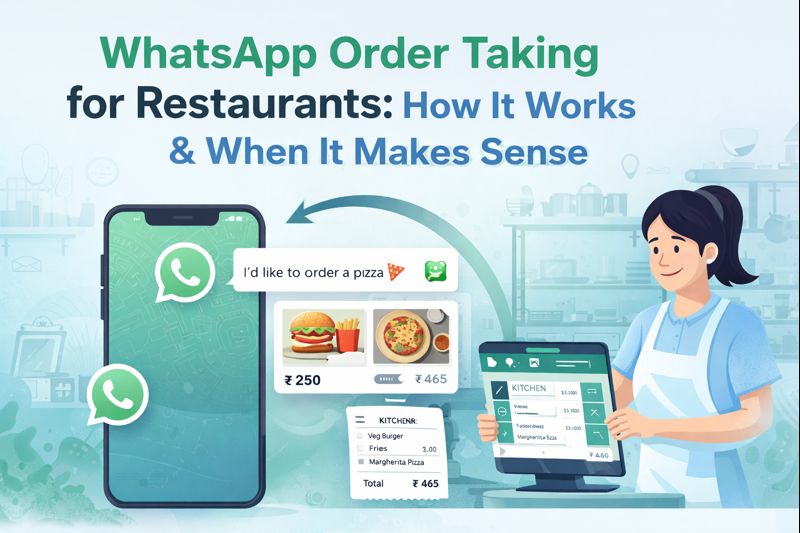
WhatsApp order taking simply means:
👉 Customers place food orders via WhatsApp instead of calling or using apps.
Typical workflow:
- Customer sends message
- Restaurant shares menu
- Order gets confirmed in chat
- Staff enters order into POS
- Kitchen processes as usual
⚠️ Important:
WhatsApp is only a communication tool - not a replacement for POS, billing, or inventory.
📊 How Restaurants Take Orders Today
1. Phone Calls
Fast but error-prone.
Problems:
- Miscommunication
- No written record
- Hard to manage during rush
2. Counter Orders
Traditional but limited.
Problems:
- Long queues
- Staff overload
- Slower service
3. Zomato / Swiggy
Convenient but expensive.
Problems:
- High commissions
- Low control over customers
👉 If you want to understand how much commission platforms like Zomato actually take and how it impacts your margins, this detailed breakdown explains it clearly.
4. WhatsApp (Middle Ground)
- Familiar
- Low friction
- Direct communication
👉 But not perfect (we’ll cover that below)
⚙️ How WhatsApp Order Taking Works (Step-by-Step)
1️⃣ Customer Initiates
“Menu please”
“2 burgers + 1 fries”
No app. No learning.
2️⃣ Menu Sharing
- Images
- Text
3️⃣ Order Confirmation
Staff confirms:
- Items
- Quantity
- Customizations
- Delivery/pickup
Everything is documented.
4️⃣ Order Entry into POS
Critical step:
👉 Orders must be entered into POS manually
Otherwise:
- No tracking
- No reporting
- No inventory sync
5️⃣ Billing & Payment
- At counter
- At delivery
- Digital billing
👉 Many restaurants combine this with WhatsApp billing to simplify checkout and reduce waiting time, especially for takeaway and delivery orders.
✅ Benefits of WhatsApp Order Taking
✔ Familiar for Customers
No learning curve → higher adoption
✔ Fewer Errors
Written orders reduce confusion
✔ Better Peak Handling
- No constant phone calls
- Parallel order handling
✔ Clear Record
Chat acts as proof
✔ Low Cost
No commissions like aggregators
❌ Limitations (Important)
Let’s be real - it’s not perfect.
❌ Manual Effort Still Required
Orders still need POS entry
❌ Can Become Messy
Too many chats = confusion
❌ No Automation (Unless advanced setup)
Unlike apps, no structured flow
❌ Response Delay Risk
Late reply = lost order
🧠 Real Restaurant Scenario
A small QSR handling ~50 orders/day switched from phone calls to WhatsApp.
Before:
- Missed calls
- Wrong items
- Staff stress
After:
- Better order clarity
- Reduced errors
- Faster peak handling
But they faced a new issue:
👉 Too many chats during rush
Solution:
- Dedicated staff for WhatsApp
- Strict POS entry process
📌 Result:
Efficiency improved - but only because process was clear
⚖️ WhatsApp vs POS vs Zomato
| Factor | POS | Zomato | |
|---|---|---|---|
| Role | Communication | Core system | Marketplace |
| Cost | Low | Medium | High commission |
| Control | High | Full | Limited |
| Automation | Low | High | High |
| Accuracy | Medium | High | High |
👉 For a detailed breakdown of restaurant POS pricing in India and what features actually matter, you can explore this guide.
🎯 When WhatsApp Order Taking Makes Sense
✅ Ideal when:
- High phone order volume
- Customers prefer messaging
- Limited staff
- Frequent customization
❌ Not ideal when:
- Very low order volume
- Only walk-in customers
- Poor internet connectivity
🏗️ How BillBoox Fits Into This
In most restaurants:
👉 WhatsApp = communication
👉 POS = system of record
BillBoox ensures:
- Orders entered properly
- Billing remains accurate
- Inventory stays tracked
- Reporting is correct
👉 No dependency on chat-based systems
Frequently Asked Questions(FAQs)
1. Is WhatsApp ordering better than Zomato?
It reduces commission but requires manual handling.
2. Can WhatsApp replace POS?
No. It only replaces communication, not operations.
3. Is WhatsApp good for small restaurants?
Yes, especially for takeaway-focused outlets.
4. Can orders be tracked properly?
Yes - if entered into POS consistently.
5. How to avoid chaos in WhatsApp orders?
Use:
- Dedicated staff
- Clear process
- POS integration
🧾 Final Thoughts
WhatsApp order taking is not about adding technology.
👉 It’s about removing friction in communication
For many restaurants, it improves:
- Order accuracy
- Customer experience
- Operational flow
But only if:
👉 It is connected properly with POS systems Otherwise, it becomes just another problem.
If you want to see how WhatsApp ordering fits into a complete restaurant workflow - from order to billing to reports.
👉 You can explore it through a demo when it fits your evaluation process.
tags :
WhatsApp order taking for restaurants
Restaurant WhatsApp orders
WhatsApp ordering system
Restaurant POS
Digital ordering restaurant
Order management
Restaurant operations
Customer communication