12 June 2026
Restaurant Operations & Management
Restaurant Inventory Not Matching Your Actual Stock? Here's Why
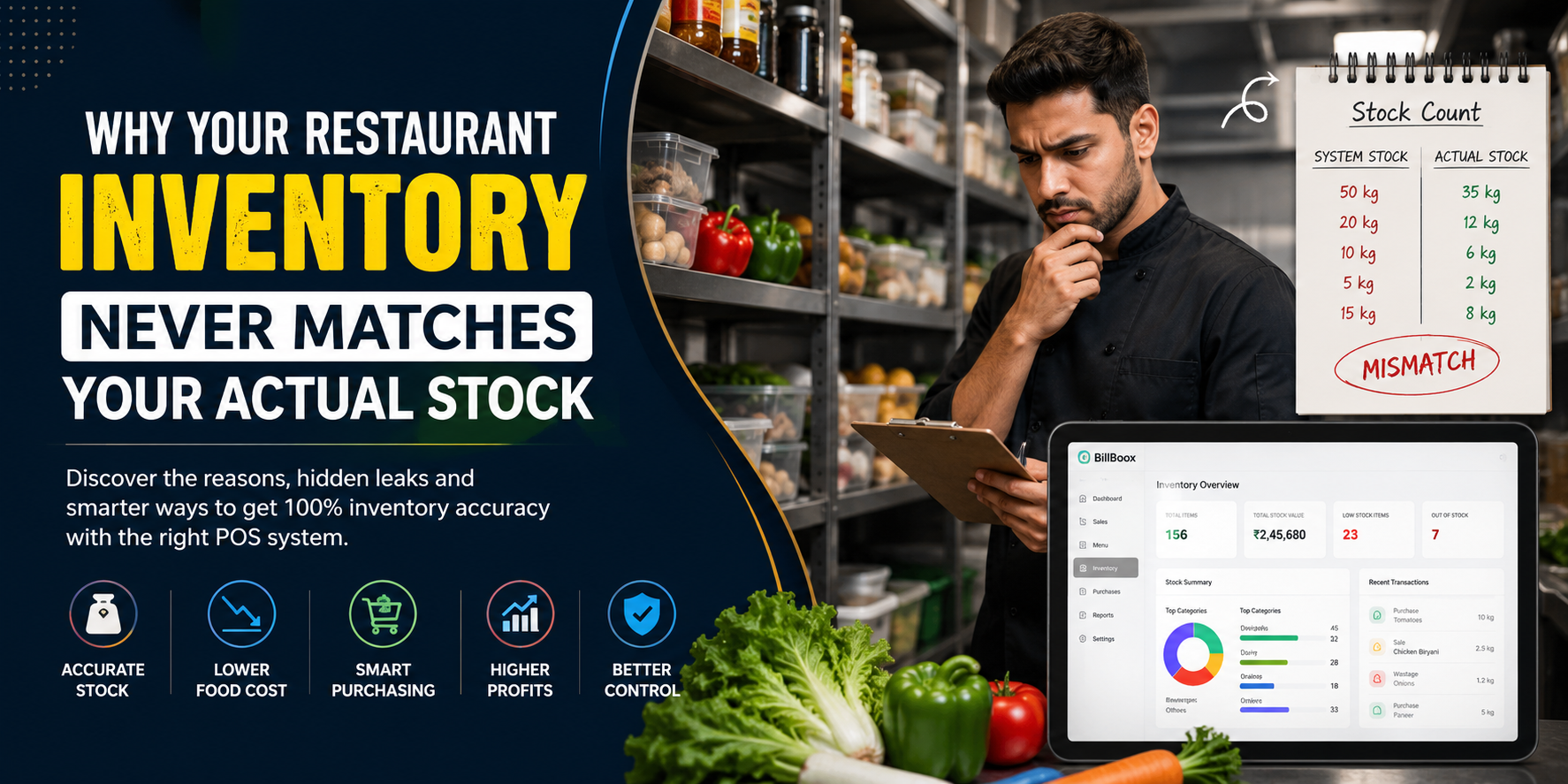
Running a restaurant is challenging enough without constantly wondering where your inventory went.
You purchased 100 kg of rice this month.
According to your records, you should still have 25 kg remaining.
But when your team performs a physical stock count, only 12 kg is actually available.
Where did the other 13 kg go?
This is one of the most common frustrations restaurant owners face.
The problem is that inventory mismatches rarely happen because of one major mistake. Instead, they occur due to multiple small operational leaks that quietly impact food costs and profitability.
If your stock records never seem to match reality, you're not alone.
In this guide, we'll explore the most common causes of inventory mismatches and how modern restaurant inventory management systems help solve them.
Why Inventory Accuracy Matters
Inventory is one of the largest expenses in any restaurant.
When inventory records are inaccurate, restaurants often experience:
- Increased food costs
- Unexpected stock shortages
- Over-ordering ingredients
- Wastage and spoilage
- Reduced profit margins
- Poor purchasing decisions
Many restaurant owners focus heavily on sales but overlook inventory accuracy until profits start shrinking.
The reality is simple:
If you cannot accurately track what enters and leaves your kitchen, you cannot accurately track profitability.
7 Reasons Your Restaurant Inventory Never Matches
1. Over-Portioning During Food Preparation
Recipes are designed with specific ingredient quantities.
However, during busy service hours, staff may unintentionally serve larger portions than intended.
Examples include:
- Extra cheese on pizzas
- Larger chicken portions
- Additional sauces and toppings
- Oversized beverage servings
Even small increases in portion size can significantly impact monthly inventory consumption.
Over time, your POS reports may indicate one level of ingredient usage while actual consumption is much higher.
2. Recipes Are Not Standardized
Many restaurants rely on staff experience rather than documented recipes.
When different chefs prepare the same dish differently, inventory consumption becomes inconsistent.
For example:
One chef uses 120 grams of paneer.
Another uses 150 grams.
Your inventory records become inaccurate because actual ingredient usage varies daily.
This is why recipe-based inventory tracking is essential for accurate food cost management.
Related Reading:
3. Food Wastage Is Not Recorded
Every restaurant generates some level of wastage.
Examples include:
- Burnt food
- Spoiled vegetables
- Expired ingredients
- Preparation waste
- Customer returns
The problem arises when wastage is never recorded.
Inventory leaves the kitchen but never appears in the system.
As a result, stock levels gradually become inaccurate.
4. Staff Meals and Complimentary Items
Many restaurants provide:
- Staff meals
- Complimentary dishes
- Promotional food samples
These items consume inventory.
However, if they are not properly tracked, stock discrepancies become unavoidable.
Inventory is reduced physically but remains unchanged in records.
5. Inventory Counting Errors
Manual stock counts often introduce mistakes.
Common examples include:
- Incorrect unit conversions
- Missed items
- Duplicate entries
- Estimation instead of measurement
Even small counting errors repeated weekly can create significant inventory variance over time.
6. Theft and Pilferage
This is an uncomfortable topic, but it cannot be ignored.
Inventory leakage can occur through:
- Unauthorized consumption
- Unrecorded ingredient usage
- Supplier delivery discrepancies
- Internal theft
Without proper tracking, these losses remain hidden for months.
Most restaurants discover the issue only after food costs increase unexpectedly.
7. Inventory Is Not Connected to Sales
This is often the biggest reason inventory records become inaccurate.
In many restaurants:
- Billing happens in one system
- Inventory is managed in spreadsheets
- Purchases are tracked separately
Because these systems are disconnected, stock updates rely entirely on manual data entry.
Manual processes inevitably create gaps.
How Modern Restaurant POS Software Solves Inventory Mismatches
Modern restaurant POS software connects sales, inventory, recipes, and reporting into a single workflow.
When a dish is sold:
- The POS records the sale
- Ingredients are deducted automatically
- Inventory updates in real time
- Food cost data remains accurate
This creates a much more reliable inventory process.
Learn more:
- Restaurant Inventory Management Software in POS
- How Restaurant Inventory Management Works in POS Software
Signs Your Restaurant Has an Inventory Leakage Problem
You may have an inventory control issue if:
- Food costs keep increasing
- Stock runs out unexpectedly
- Physical inventory rarely matches reports
- Purchasing volume continues rising
- Profit margins are shrinking despite healthy sales
These warning signs usually indicate deeper inventory management problems.
Best Practices for Improving Inventory Accuracy
Standardize Recipes
Use documented recipes for every menu item.
Record Wastage Daily
Track spoilage, preparation waste, and damaged inventory.
Conduct Regular Stock Audits
Perform weekly or monthly physical inventory checks.
Track Staff Consumption
Record all staff meals and complimentary items.
Use Inventory-Integrated POS Software
Automated inventory tracking reduces manual errors and improves visibility.
For additional strategies, read:
Frequently Asked Questions(FAQs)
1. Why does restaurant inventory never match actual stock?
Inventory mismatches typically occur because of over-portioning, recipe inconsistencies, food wastage, staff meals, counting errors, theft, and disconnected inventory systems.
2. How often should restaurants perform inventory audits?
Most restaurants should conduct weekly inventory checks for high-value items and monthly audits for complete stock verification.
3. Can POS software automatically track inventory?
Yes. Modern restaurant POS software can deduct ingredients automatically based on recipe usage whenever a dish is sold.
4. What is inventory leakage in restaurants?
Inventory leakage refers to stock losses caused by wastage, theft, over-portioning, spoilage, or unrecorded consumption.
5. How can restaurants reduce inventory discrepancies?
Restaurants can reduce discrepancies by standardizing recipes, recording wastage, conducting audits, and using inventory-integrated POS software.
6. Does inventory management help reduce food cost?
Yes. Better inventory visibility helps identify wastage, control purchasing, and improve food cost accuracy.
Final Thoughts
Inventory mismatches rarely happen because of a single issue.
They are usually caused by a combination of:
- Portion inconsistency
- Recipe variation
- Wastage
- Manual tracking
- Inventory leakage
- Poor operational visibility
The good news is that these problems can be identified and controlled with the right processes and tools.
Restaurants that connect inventory management with their POS system gain better visibility into ingredient usage, food costs, and profitability.
If your inventory reports never match actual stock, it may be time to evaluate how inventory is being tracked across your operation.
Book a Free Demo with BillBoox to see how inventory-linked restaurant POS software helps restaurants reduce food cost, improve stock accuracy, and gain better control over profitability.
Author
BillBoox Team helps restaurants, cafés, cloud kitchens, and multi-outlet food businesses improve profitability through inventory control, billing automation, kitchen operations management, food cost tracking, and restaurant POS technology.
Disclaimer
This article is intended for educational and informational purposes only. Inventory challenges and results may vary based on restaurant size, operational processes, menu complexity, and staff practices. Readers should evaluate inventory management solutions based on their specific business requirements. BillBoox provides restaurant management software designed to improve operational visibility and inventory control.
tags :
Restaurant inventory management
Restaurant Inventory Software
Restaurant pos inventory
Food cost control
Restaurant Stock Management
Inventory Leakage
Food Wastage
Recipe Management Software
Restaurant operations
POS Inventory Tracking